


A few weeks ago I was on a call with a client in the windows and siding business. They run a tight operation: move into a local market, run ads hard for four to five weeks, generate as many leads as they can, then move on to the next city.
They’d been running Google Ads for a while and weren’t happy with the results. Decent budget, right keywords, but the leads weren’t coming in the way they expected. When I pulled up the account, the problem was obvious.
Google had recommended Maximize Conversions. The client had followed that advice. And it was quietly draining their budget.
The manual CPC vs smart bidding question and why timing is everything
This comes up constantly when I’m auditing accounts, and it’s one of the most important questions in Google Ads that most people get wrong: should you use manual CPC or smart bidding?
The honest answer is: it depends entirely on how long your campaign has been running and how much conversion data you have.
Google’s smart bidding strategies work by learning from your past campaign data. The more conversions they’ve seen, the better they get at predicting which clicks are worth bidding on. The problem is that word “past.” If you’re starting a new campaign or running a short four-to-five week push like my client, there is no past. There’s nothing for the algorithm to learn from.
So instead of optimizing, it guesses. Google calls this “learning mode.” I call it paying Google to figure things out on your dime.
What was actually happening in the account
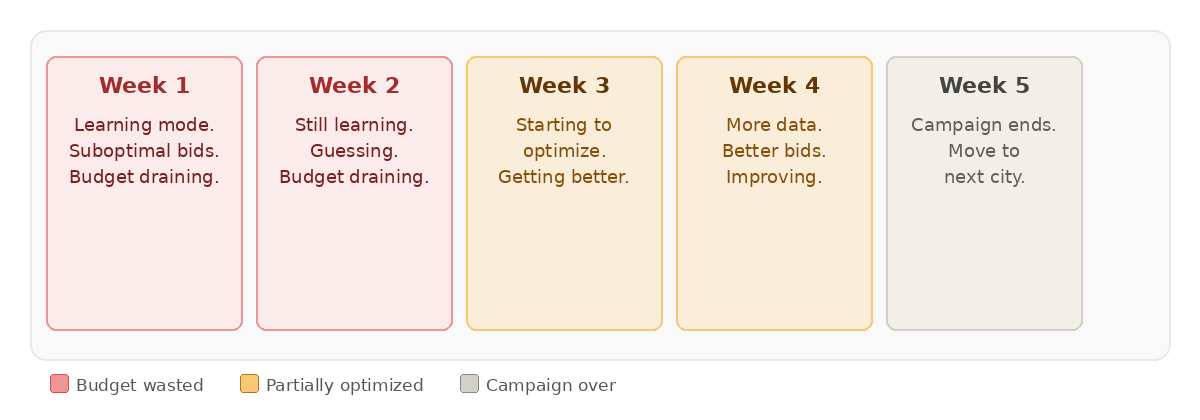
When I looked at the campaign timeline, the pattern was clear. The first one to two weeks of every market push were almost entirely wasted. The algorithm was in learning mode, making suboptimal bids, burning through budget while it collected the data it needed to start making good decisions.
By week three it was starting to get its bearings. But by week four or five the campaign was wrapping up and they were moving to the next market, where the whole cycle started over from zero.
Every single market push began with a fresh slate. No historical conversion data. No learning carried over. Just a brand new campaign in a brand new city, handed straight to an algorithm that had nothing to work with.
It was the worst possible match between campaign structure and bidding strategy.
The fix: manual CPC for short, geo-targeted campaigns
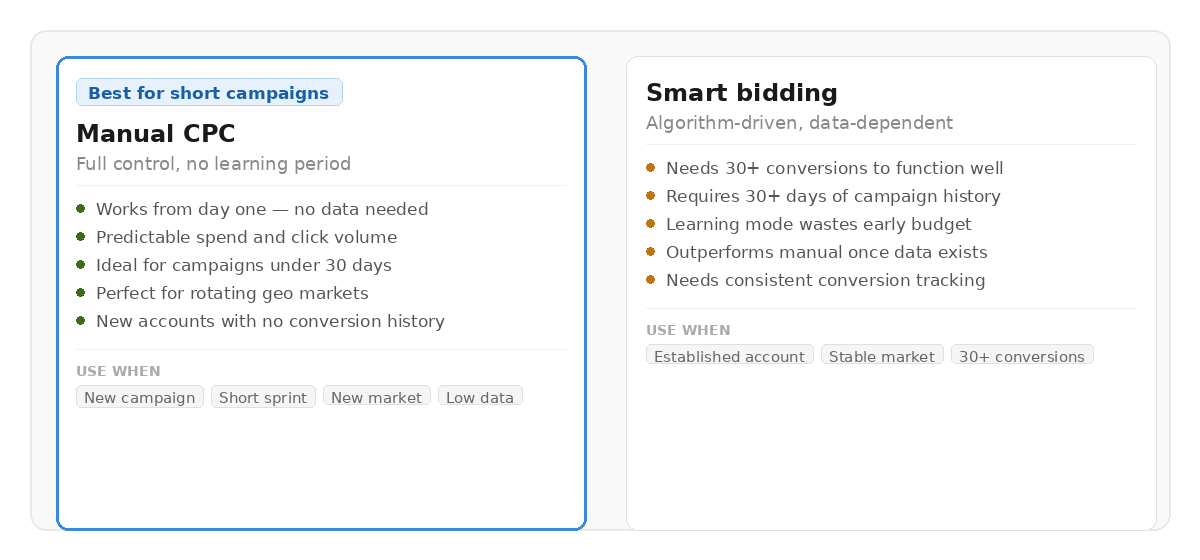
When you’re running a short campaign in a new market, manual CPC vs smart bidding is not really a debate. Manual CPC wins every time.
With manual CPC, you set the maximum you’re willing to pay per click and Google bids that amount. No learning period. No algorithm fumbling through week one and two trying to figure out your audience. You’re in control from day one.
For this client, we set a starting bid based on the estimated top-of-page bid from Google’s Keyword Planner, around $5 per click against a daily budget of $80. That gave us a predictable 10 to 15 clicks per day right from the start of each new market push. Not glamorous, but every dollar was working from day one.
When smart bidding actually makes sense
This is not a case against smart bidding. When it has the right conditions, it genuinely outperforms manual CPC. Those conditions are:
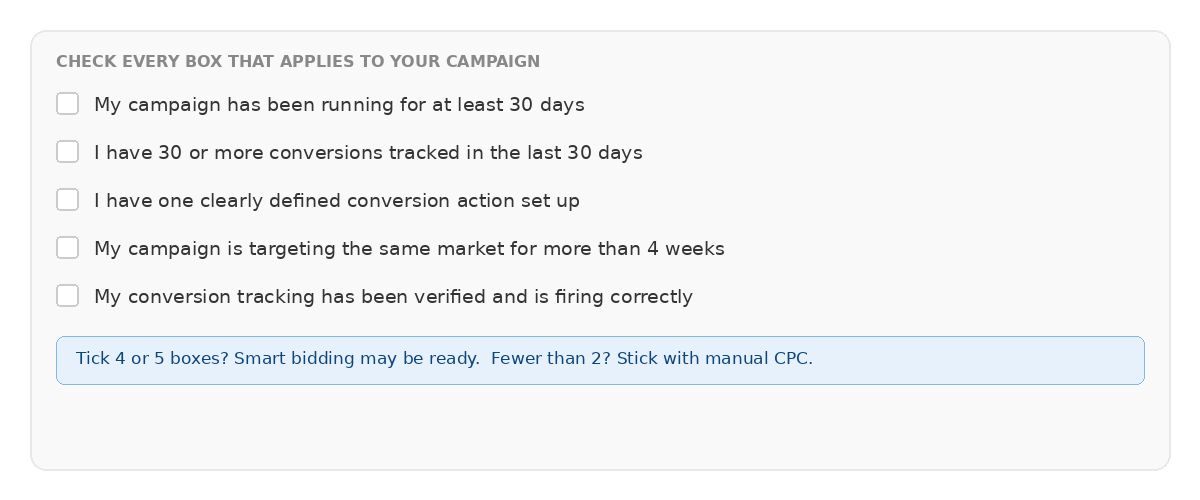
- Your campaign has been running for at least 30 days in the same market
- You have 30 or more conversions tracked in the account
- You have one consistent, clearly defined conversion action: form fills, calls, or purchases, not all three blended together
Hit those three and the algorithm has something real to work with. For a business model like this client’s, running four-to-five week sprints in rotating markets, those conditions will almost never be met.
The broader lesson
Google’s default recommendations are designed for the average account. The average account has been running for months, has steady conversion data, and is not picking up and moving to a new city every month.
If your business does not look like the average account, the default recommendations are probably not right for you.
The manual CPC vs smart bidding decision should always come down to one question: does the algorithm have enough data to make better decisions than I can make manually? If the answer is no, and for short, geo-targeted campaigns it almost always is, keep control and use it.
For this client, we locked in manual CPC across every new market push. The wasted early-campaign budget stopped. Leads started coming in from day one. And they had a bidding strategy that actually matched how their business works.
Frequently asked questions: manual CPC vs smart bidding
Is manual CPC still worth using in 2026?
Yes, for the right situation. Manual CPC gets a bad reputation because most advice is written for established accounts with months of conversion data. For new campaigns, short geo-targeted pushes, or any situation where the algorithm does not have enough to learn from, manual CPC is the more effective choice. It is not outdated. It is just misapplied when people use it by default instead of by design.
How many conversions does Google need before smart bidding works properly?
Google’s own guidance points to at least 30 conversions in a 30-day period before smart bidding strategies like Target CPA or Maximize Conversions can optimize effectively. Some strategies like Target ROAS may need 50 or more to work reliably. Below those thresholds the algorithm is largely guessing, and you are paying for that guesswork.
What happens if I use smart bidding before I have enough data?
The campaign enters learning mode, which is Google’s term for the period when the algorithm is collecting data before it can make reliable decisions. During this time bids are inconsistent and often inefficient. For a short campaign, you may never fully exit learning mode, meaning the entire budget runs during the algorithm’s least effective period.
Can I switch from manual CPC to smart bidding mid-campaign?
Technically yes, but switching bidding strategies mid-campaign triggers a new learning period and resets the algorithm’s progress. If you’re planning to eventually move to smart bidding, it’s better to start with manual CPC, build up conversion data, and then switch at the start of a new campaign or budget cycle rather than disrupting one that’s already running.
Does smart bidding work for local service businesses?
It can, but only if your campaigns run long enough in the same market to accumulate data. For businesses that rotate through local markets on a four-to-five week cycle, smart bidding almost never has time to learn before the campaign ends. Manual CPC is almost always the better fit for that model.
What’s a good starting bid for manual CPC?
Use Google’s Keyword Planner to find the estimated top-of-page bid range for your target keywords in your specific location. That gives you a realistic anchor. Start at or slightly below that number and adjust based on what you’re seeing in the first week. Impression share, average position, and click-through rate will tell you quickly whether you need to bid up or down.
Should I use enhanced CPC instead of manual CPC?
Enhanced CPC is a middle-ground option that lets you set bids manually but allows Google to adjust them slightly based on conversion likelihood. It can be a useful transition step when you’re building toward smart bidding, but it still requires a reasonable amount of conversion data to work well. For brand new campaigns or short market pushes, straight manual CPC keeps things simpler and more predictable.
Get a second opinion on your Google Ads setup.
Most audits I run for local service companies uncover the same patterns: the wrong bidding strategy for the campaign timeline, conversion tracking that isn’t firing correctly, or budget being burned during learning mode before a single real lead comes in. If any of that sounds familiar, let’s take a look. Request an audit and I’ll give you a straight assessment of what’s working, what isn’t, and what to fix first.
Request a Google Ads Audit


