


Almost every discovery call I take starts the same way. Someone reaches out because their Google Ads aren’t working. Cost per lead has crept up, conversions have dried up, or a campaign that used to perform well has quietly stopped delivering. They’ve usually already tried a few things on their own. Maybe they paused some keywords, rewrote an ad or two, raised the budget hoping volume would fix it. By the time we get on a call, they’re frustrated, and they want to talk about Google Ads.
So we do. I ask about their account structure, their match types, their Quality Scores, their conversion tracking. But that’s not really where the conversation stays. Within the first fifteen minutes, I’m usually asking questions that have nothing to do with Google Ads at all.
I’ll ask what happens after someone fills out their contact form. Not in theory, but literally, step by step. Who sees it first? How long does it sit before anyone responds? Is it a phone call or an email? I ask where their leads actually live. A CRM, a shared inbox, a spreadsheet someone updates when they remember to, a notepad by the phone. I ask what their website says in the first five seconds someone lands on it, and whether that matches what the ad promised. I ask what happens if I called their business right now pretending to be a customer. Would someone pick up? Would that person know what to say?
None of these questions are trick questions. They’re the questions I’ve learned to ask because, over the years, I’ve realized the Google Ads account is rarely where the real problem lives. It’s usually just the place where the problem becomes visible.
By the thirty minute mark, the conversation has usually moved well past advertising. We’re talking about their CRM, or the lack of one. We’re talking about how fast their sales team follows up, and whether “fast” means minutes or days. We’re talking about their website’s messaging, their offer, their booking process, what happens to a lead after the first call goes unanswered. This is usually where the conversation changes. I can see it happen. Someone came in thinking they had an ads problem, and partway through the call, I can watch them start to realize the real issue is somewhere else entirely.
I don’t force that shift. It happens naturally, because that’s genuinely where the answers are.
Google Ads doesn’t create problems. It exposes them.
Google Ads doesn’t create marketing problems. It exposes them.
One thing I’ve noticed after auditing hundreds of accounts is that Google Ads is an unusually honest channel. It doesn’t forgive weak follow-up. It doesn’t forgive a confusing website. It doesn’t forgive a business that can’t answer the phone during business hours. Organic traffic and referrals can survive those weaknesses because the people arriving through them already trust the business, or they’re patient enough to wait for a callback, or they found the business through a friend who vouched for it first. Paid traffic doesn’t come with that built-in patience. A cold click either converts quickly or it doesn’t convert at all.
That’s why Google Ads tends to take the blame. It’s the newest, most visible, most expensive thing in the room, and when growth stalls, it’s the easiest place to point. But in my experience, what actually happened is that Google Ads turned on a light in a room that already had problems in it. The traffic didn’t create the leaky follow-up process or the vague homepage or the disconnected sales handoff. It just made those things impossible to ignore, because now there’s a cost attached to every click that walks through the door and leaves without buying anything. It’s not that the ads failed. It’s that everything downstream of the click was never built to catch what the ads were sending it.
Marketing audits often become business audits. I’ll open an account expecting to look at bidding strategy and keyword match types, and within an hour I’m looking at how leads move through a business from the moment they arrive to the moment they either become a customer or disappear. Every Google Ads audit I run tells a story about how the business operates, not just how it markets itself. You can see it in the gaps. A high volume of form fills with a low number of booked appointments tells you something happened between the form and the phone. A strong click through rate with a weak conversion rate tells you something didn’t match up between the ad and the landing page, or the landing page and the offer, or the offer and what the sales team actually delivers on the call.
I’ve learned to read those gaps the way a mechanic listens for a specific sound in an engine. The account isn’t broken. It’s telling you exactly where to look.
The account isn’t broken. It’s telling you exactly where to look.
Why marketing ends up scattered across five vendors
It’s worth pausing on how this happens, because it’s not a result of bad decisions. Most business owners I work with are smart, capable people who built something real. The scattering happens gradually, almost invisibly, because of how growth actually unfolds for most companies.
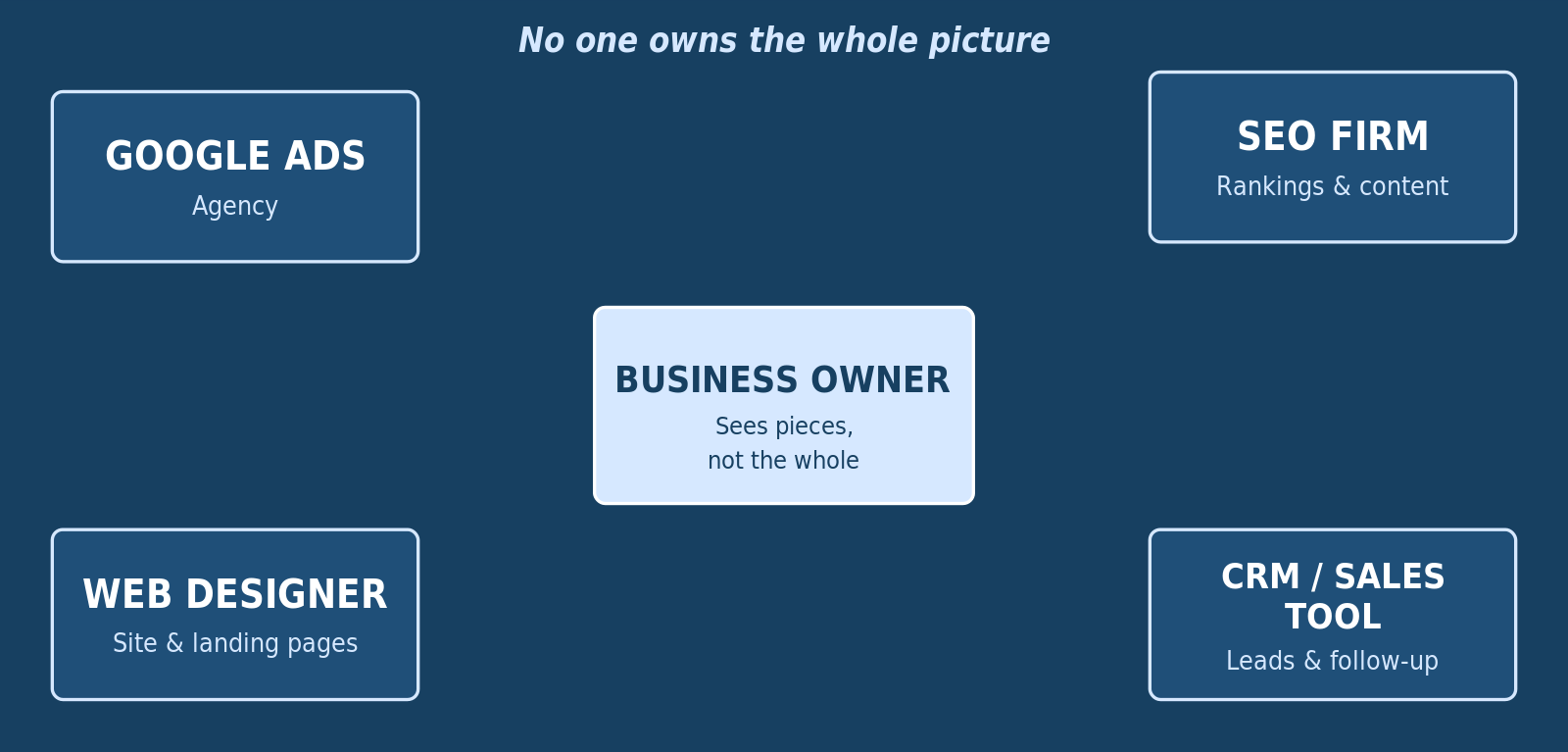
A business usually starts with something that works. Word of mouth, a referral network, maybe a listing that ranks well without much effort. Growth stalls, and the owner looks for the next lever. They hire a freelancer to run some Facebook ads, or they bring in an agency for SEO, or they finally get a real website built because the old one was embarrassing. Each of these decisions makes sense in isolation. Each vendor is good at their specific piece. The problem is that nobody was ever hired to own the whole thing.
The Google Ads specialist is measured on cost per lead inside the ads platform. The SEO agency is measured on rankings and organic traffic. The web designer is measured on how the site looks and whether the client is happy with the launch. None of them are incentivized to ask what happens to a lead after it leaves their channel, because that’s technically not their job. I’ve sat in on calls where three different vendors each believed their piece was performing well, and the business owner was the only person in the room who could see that leads were still not turning into customers. Nobody was lying. Nobody was underperforming by the metric they were being measured against. The system just didn’t have anyone watching the whole board.
Once those silos exist, they’re genuinely hard to break, and not just for logistical reasons. There’s a psychological pull toward keeping things the way they are. Each vendor points to their own dashboard as proof they’re doing their job well, and it’s hard to argue with a rankings report or a cost per click graph in isolation. Untangling the actual source of a problem means asking uncomfortable questions across departments and vendors at the same time, which is a different kind of work than optimizing a campaign. It’s easier, in the short term, to just ask the ads person to lower cost per lead again, because that’s a concrete, familiar request. Fixing the follow-up process, or rebuilding a CRM workflow, or rewriting an offer, touches parts of the business that feel further from marketing and closer to operations. Most people don’t reach for that fix first, even when it’s the right one.
Movement isn’t the same as progress
There’s a pattern I’ve watched play out enough times that I’ve stopped being surprised by it. A business ramps up spend, adds a channel, launches a new campaign, and activity goes up across the board. More impressions, more clicks, more leads in the pipeline, more content going out. Everyone feels busier. It feels like things are working. If that sounds familiar, the busyness itself usually isn’t the problem. It’s mistaking it for proof that something is.
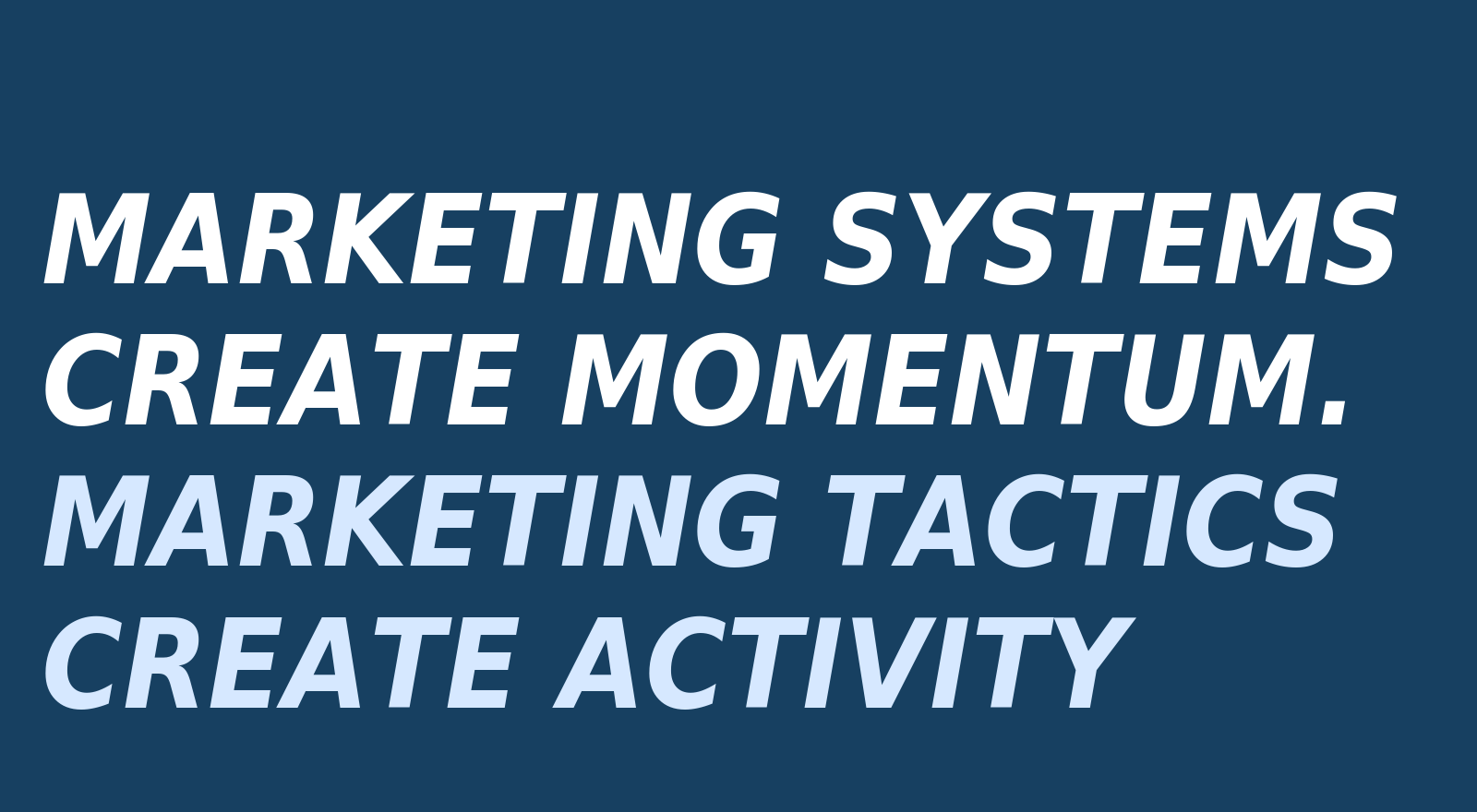
Activity and progress aren’t the same thing. Businesses often mistake movement for progress. I think of it as the difference between tactics and systems. Marketing systems create momentum. Marketing tactics create activity. A new ad campaign, a blog post, a landing page redesign, a CRM tool nobody fully adopted, these are all individually useful, but on their own they just add motion. A system is what happens when those pieces are actually connected, feeding information back and forth, so that a lead captured by an ad ends up in a CRM that triggers a fast follow-up, informed by messaging that was shaped by what the sales team has learned actually closes deals, tracked by analytics that tell you which parts of that chain are working and which aren’t. Systems create momentum, because each part makes the next part more effective. Tactics without that connective tissue just create more noise inside the same broken chain.
What the leaks actually look like
A few patterns show up often enough that I think of them as recurring, even though every business I work with is different.
One client came to me convinced their Google Ads account had stopped working. Cost per lead had climbed from around $70 to over $140 in four months, and their sales team was closing fewer deals than the same time the previous year. We went through the account in detail, keywords, ad copy, landing pages, and honestly, none of it looked broken. What surprised me wasn’t that the account was clean. It was how long it took the business to find out why it didn’t matter that the account was clean. Leads submitted through the website weren’t being followed up with for eighteen to twenty four hours on average. They were landing in a shared inbox that got checked once, sometimes twice a day, and by the time anyone called back, the person had already booked with a competitor who answered faster. The fix had nothing to do with the ads. It was building a response protocol and routing leads directly to someone’s phone the moment they came in. Within three weeks, without a single change to the campaigns, cost per lead was back under $75. The ads were never the problem.
Another business was generating a healthy volume of leads every month, close to 150, enough that on paper the marketing looked like it was doing its job. But those leads were living across three places, a form notification email, a spreadsheet one salesperson kept, and a paper notepad by the front desk phone. When we actually reconciled the three, close to 20 percent of the leads coming in every month had never been contacted at all. Nobody had a full view of who had been reached, who hadn’t, or who had gone cold. Leads weren’t lost because the campaigns were weak. They were lost because there was no system holding onto them once they arrived. Once we got everything flowing into a single CRM with basic automation for follow-up reminders, the business didn’t need more leads to grow. They needed to stop losing the ones they already had, and that alone was worth more than a 20 percent increase in ad spend would have been.
A third example sticks with me because it ran against the instinct most people have when a campaign underperforms, which is to change the campaign. This business had decent traffic and a reasonable click through rate, but their landing page was converting at just under 2 percent, well below what similar accounts were seeing. Instead of touching the ads, we looked at the offer itself, what was actually being promised on that page. It was vague and generic, similar to what every competitor in their space was saying. We tightened the offer, made it specific and a little bolder, backed by something they could genuinely deliver. Same traffic. Same campaigns. Same budget. Within a month, conversion rate was sitting just under 4 percent. The lever that mattered wasn’t inside the ads platform at all. It was in what the business was actually offering once someone showed up.
I share these patterns because I think they’re common enough that most business owners reading this will recognize a version of at least one of them in their own operation, even if the details don’t match exactly.
Building the marketing operating system, not another tactic
None of this means Google Ads doesn’t matter, or that campaign quality is irrelevant. It matters a great deal, and a poorly built account absolutely can hold a business back. But in my experience, the businesses that get consistent, compounding results aren’t the ones with the single best campaign. They’re the ones where the website, the ads, the SEO, the CRM, the analytics, the content, the sales process, and the customer experience are all talking to each other, informed by the same data, working toward the same definition of a good customer.
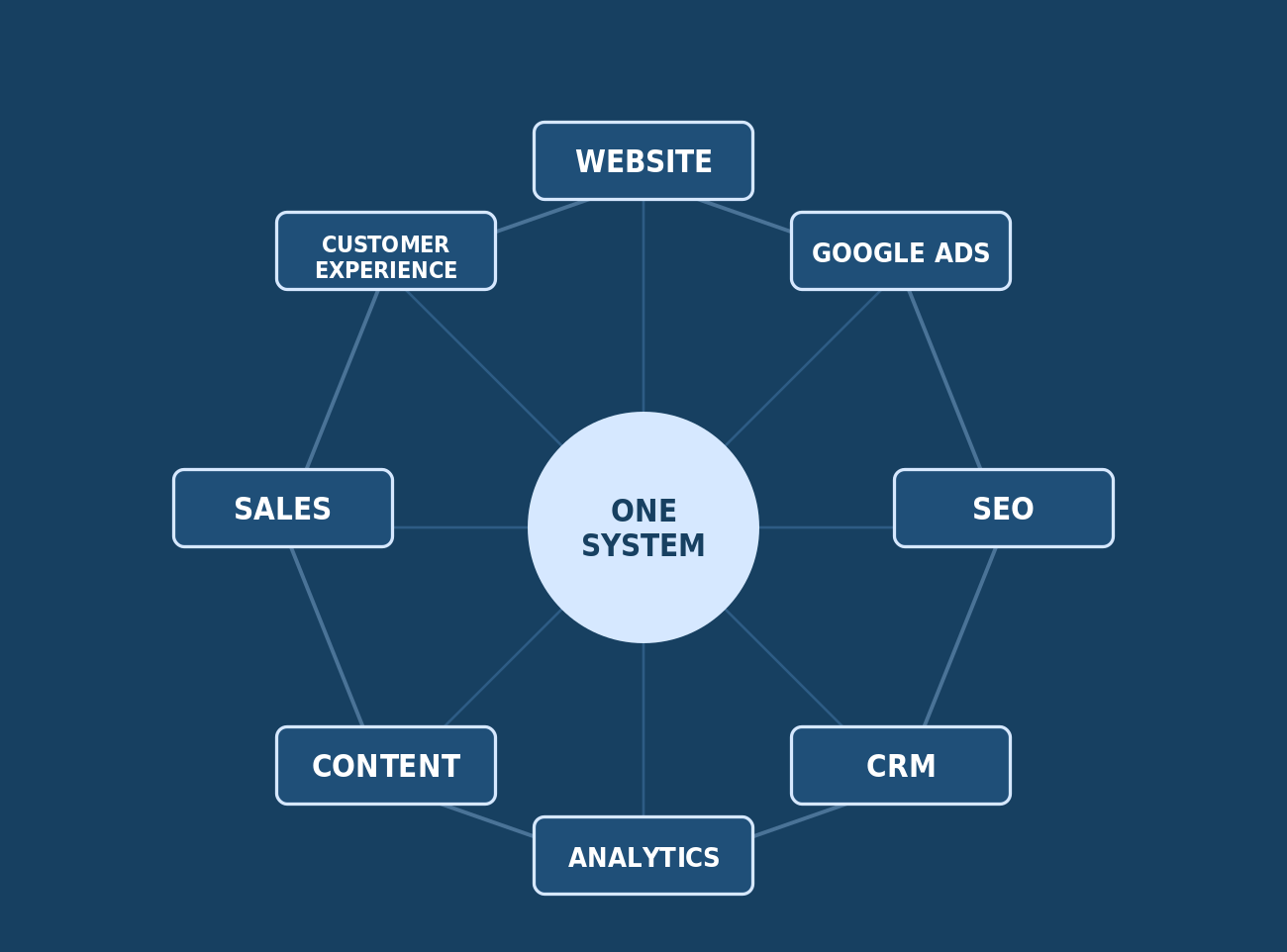
When those pieces are connected, something changes. The offer that performs best in a Google Ads campaign informs the messaging on the website and in outbound sales conversations. The questions prospects ask on sales calls shape the content that gets written next. The CRM data on which leads actually close informs which keywords and audiences deserve more budget. Each part gets a little smarter because of what the other parts are learning. That’s what I mean when I talk about building a marketing system rather than running marketing tactics. It’s less about adding more channels. It’s about making the channels you already have actually talk to one another.
A few questions I get asked a lot
Why isn’t my Google Ads working?
In most cases, it still is. What’s usually happening is that the account is doing its job, sending clicks and leads into the business, and something downstream, a slow follow-up, a missing CRM, a landing page that doesn’t match the ad, is where those leads actually get lost. Before touching the campaign, trace what happens to a lead after the click, or have someone run a full audit on the account for you.. That’s almost always where the real answer is.
What is a marketing system?
A marketing system is what you get when your website, ads, SEO, CRM, analytics, content, and sales process are all connected and feeding the same data back and forth, instead of operating as separate, disconnected tactics. It’s the difference between activity and momentum. Tactics run in isolation. A system compounds. This is the exact kind of work I do with clients.
Why isn’t my marketing working even though I’m spending more?
This is usually a systems problem, not a budget problem. More spend adds activity, more clicks, more leads, more content, but if the pieces underneath aren’t connected, that activity doesn’t compound into anything. Fixing the connections between channels tends to move the needle more than adding another one.
A different question to ask
So here’s what I’d leave you with, instead of the usual next step. The next time a campaign underperforms, before you ask what’s wrong with the ads, try asking a harder question: what is this campaign showing me about the rest of my business?
Take one lead that came in this week and trace it, step by step, exactly the way it actually happened. Not how it’s supposed to work. How it really moved, from the moment they clicked, to the moment someone responded, to whatever happened after that. Somewhere in that chain, there’s probably a gap you haven’t looked at closely in a while.
Google Ads didn’t put it there. It just turned the light on.


