


I’ve been watching a slow-motion disruption unfold in digital marketing for the past two years. Most businesses haven’t noticed yet. The ones that have are quietly building an advantage that will be very difficult to close.
At Google I/O 2026, the company called what it unveiled “the biggest change to Search in 25 years.” That’s not marketing language. When only 23% of Google searches now send users to the open web — and click-through rates at position #1 have dropped from 27% to 11% — that’s a structural shift, not a trend.
The question I’ve been focused on, and the one I want to walk you through here, is this: what actually works in a world where AI gives the answer before anyone visits your website?
The answer, perhaps counterintuitively, is community. And I want to explain exactly why — and give you a framework you can start applying this week.
What Changed at Google (And Why It Changes Everything for You)
Before I get into strategy, I want to ground this in what’s actually happening with search right now, because the numbers are genuinely striking.
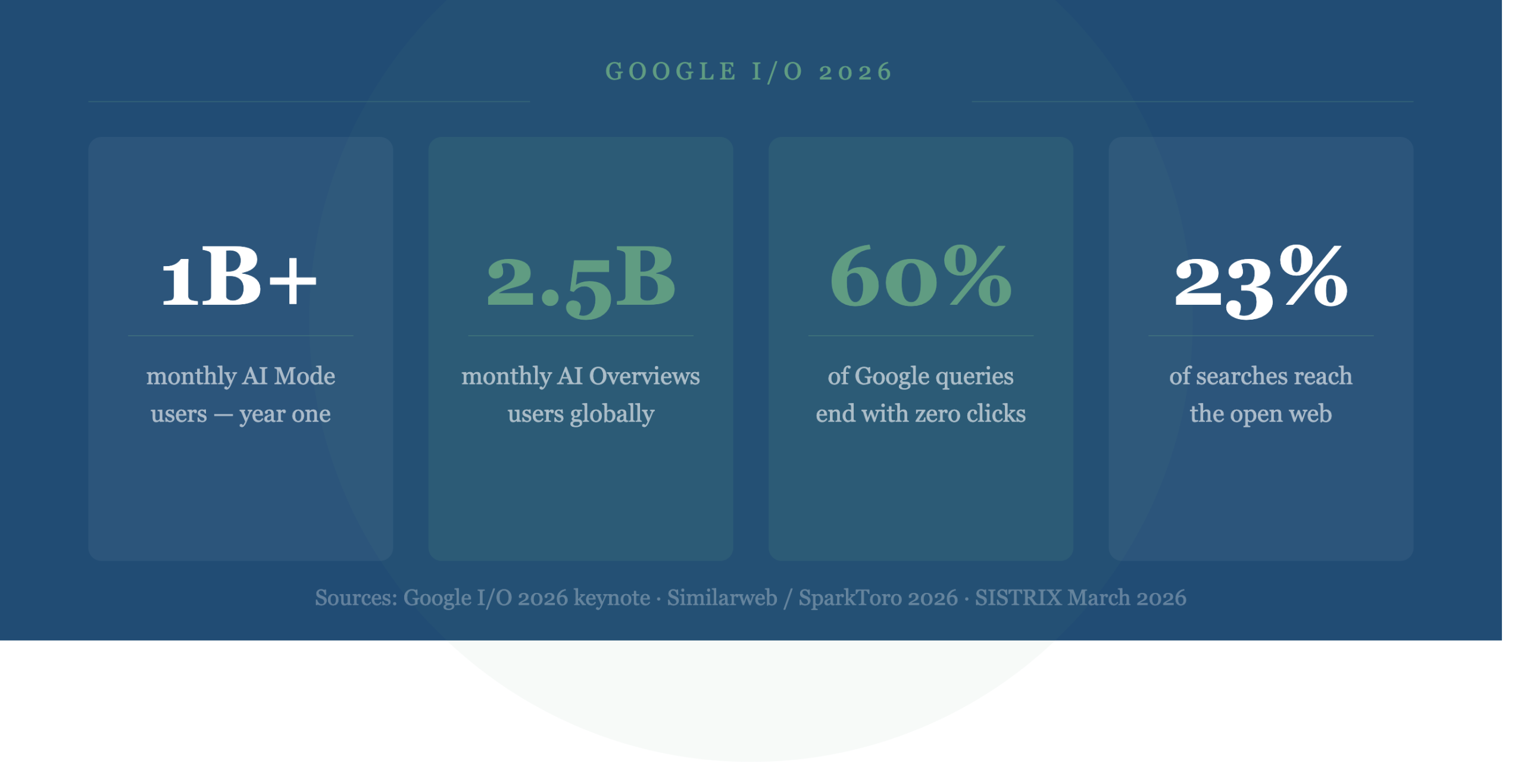
Google AI Mode — the conversational AI search interface launched at I/O 2025 — crossed 1 billion monthly users in its first year. AI Overviews, the AI-generated summaries that now appear above traditional results, reach 2.5 billion monthly users. That means more than half of everyone who uses Google now regularly sees AI-generated content before they see a single blue link.
The downstream effect on traffic is measurable and significant. SISTRIX data from March 2026 shows the click-through rate at Google’s top organic position has fallen from 27% to 11%. Research from SparkToro and Similarweb puts 60% of all Google queries ending with zero clicks — the user got their answer and moved on without visiting any website.
Here’s the number I find most clarifying: only 23% of Google searches now send traffic to the open web. The rest stays inside Google’s ecosystem or ends without a click.
If your current marketing strategy is built around ranking well and capturing organic traffic, you’re optimising for a pie that’s getting meaningfully smaller every quarter.
But — and this is the part most people miss — it’s not that search has become less valuable. It’s that the value has moved. It’s moved from ranking to being cited. From showing up in results to being the source that AI trusts and quotes.
That shift is what Answer Engine Optimisation (AEO) is about. And it’s where community becomes your biggest competitive advantage.
What Is AEO and How Is It Different from SEO?
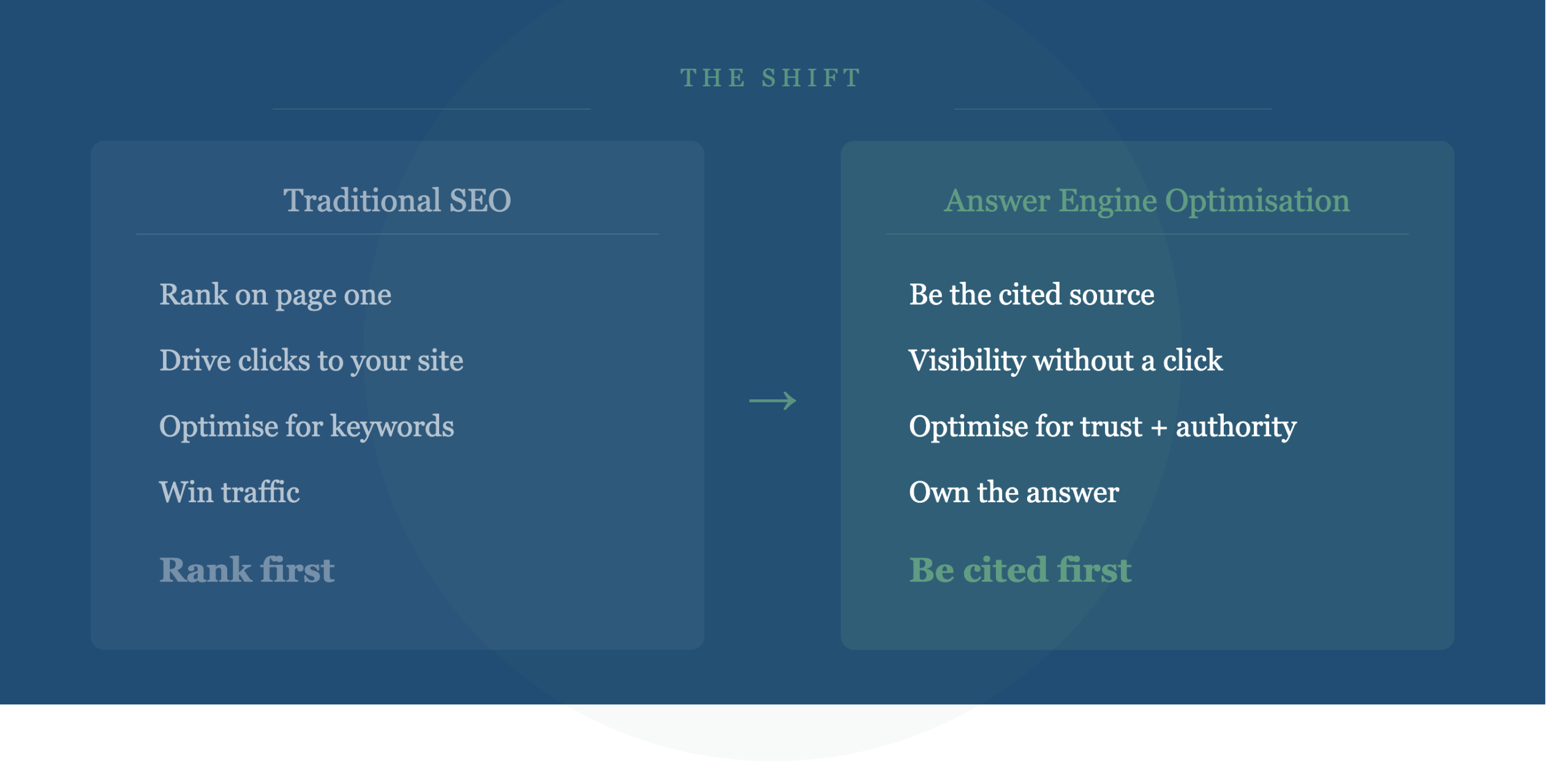
Traditional SEO is about ranking. You optimize your content and build authority so that Google places your pages high in the results and users click through. The goal is traffic.
AEO is about citation. You structure your content and build credibility so that AI answer engines — ChatGPT, Perplexity, Google AI Mode, Microsoft Copilot — select your brand as the trusted source when generating answers. The goal is visibility inside the answer itself, whether or not a click follows.
The practical difference matters for how you create content. SEO asks: how do I rank for this keyword? AEO asks: would an AI engine cite this as the definitive answer to this question?
Those are different questions, and they lead to meaningfully different content decisions.
Why Community Is the Unfair Advantage Most Brands Aren’t Using
Here’s the insight that changed how I think about AEO strategy: AI engines treat community content as primary evidence, not as a supporting signal.
A panel of SEO experts at SMX 2026 put it simply: “Brand is the new backlink for AI SEO.” What they meant is that in an AI search world, the signals that build authority have shifted. It’s no longer primarily about how many sites link to you. It’s about how many trusted sources mention you, discuss you, and validate you across the web.
Research analyzing millions of AI-generated citations makes this concrete. Approximately 50% of all citations across major AI platforms come from community platforms — Reddit, forums, review sites, Q&A communities, YouTube, and user-generated content of all kinds. Reddit alone appears in 46.7% of Perplexity responses.
Why? Because in December 2022, Google formalised what it calls E-E-A-T: Experience, Expertise, Authoritativeness, and Trustworthiness. The addition of “Experience” was significant. Google explicitly recognised that firsthand human experience is a quality signal that algorithms alone can’t replicate. AI engines have followed the same logic. They look for real human voices discussing real experiences, because that’s what credibility actually looks like.
Your brand content — no matter how well-written — will always look like what it is: a brand talking about itself. Community content — reviews, forum discussions, case studies told from the client’s perspective, questions answered in your Facebook Group — looks like something different. It looks like evidence.
The businesses winning at AEO right now aren’t necessarily the biggest or the ones with the most content. They’re the ones with the most trusted, consistent presence across multiple sources. And community-led businesses — by definition — are building that.
The 4A Framework: Answer, Activate, Amplify, Audit
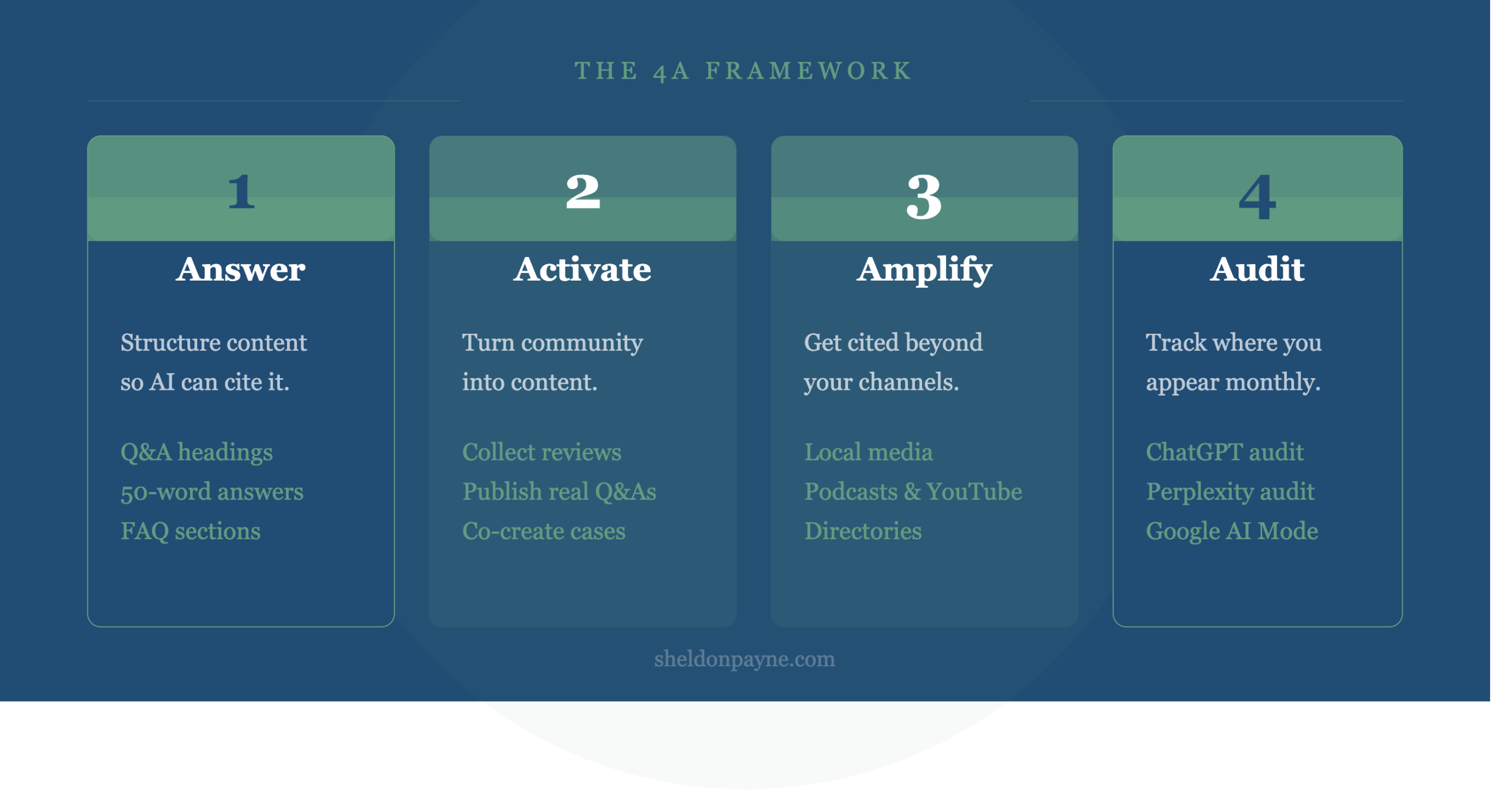
After working through this with clients and testing it against what the research consistently shows, I’ve landed on a four-part framework that I think gives any business a practical path to AEO visibility. I call it the 4A Framework.
1. Answer
The first pillar is about restructuring your content so AI engines can understand and cite it.
AI answer engines pull from content that is clear, direct, and structured for retrieval. The practical checklist here is straightforward:
Use question-based H2 headings. Instead of “Our Services,” write “What does a digital marketing consultant in [your city] actually do?” The question format mirrors how people ask things in AI tools, and it signals relevance directly.
Put your direct answer in the first 50 words of every key section. AI engines don’t have time to read your throat-clearing. The answer should be the first thing in the section, not the conclusion of it.
Add a FAQ section to every important page. Five to ten questions, each answered in two to four sentences. This is the easiest AEO win available to most businesses right now.
Write pages that are 800–1,500 words with clear, scannable structure. Thin content rarely gets cited. Neither does content that buries the answer in paragraphs of preamble.
Use plain language. Jargon signals insider communication, not authoritative explanation. Write for someone who is smart but unfamiliar with your industry.
2. Activate
The second pillar is about recognising that your community’s words carry more weight with AI than yours do — and making it easy for them to create the content that helps you.
Practically, this means:
Systematically ask for reviews. Google Business Profile, Clutch, G2, Trustpilot, LinkedIn recommendations. Every indexed, crawlable review from a real client is an AEO asset. The businesses that ask consistently have a meaningful advantage over those that ask occasionally.
Turn real client questions into content. Every question you receive in a DM, a sales call, or an email is a content brief. Document them. Answer them publicly on your website. This creates exactly the kind of question-and-answer content AI engines prioritise.
Create indexed community spaces. A LinkedIn newsletter, a Facebook Group, a community forum on your site — any space where real people discuss real problems in your niche generates the kind of authentic dialogue that AI engines treat as credible evidence.
Co-create with clients. Case studies and testimonials written from the client’s perspective, in their language, outperform brand-written content in AI citation patterns. Give clients a simple template and make the process easy.
3. Amplify
The third pillar is about getting mentioned beyond your own channels. Multi-source consensus is one of the strongest trust signals AI engines use, and it requires that your brand appear consistently across sources you don’t control.
This is where the “brand is the new backlink” insight becomes operational:
Pitch local media and industry publications. A quote in a CBC story, a contributed piece in a trade publication, a mention in an industry newsletter — each one is a citation that AI engines can find and weight.
Guest on podcasts and YouTube channels. Audio and video content is increasingly indexed and cited. A thoughtful interview on a well-regarded industry podcast generates the kind of third-party validation that’s very difficult to manufacture through owned content.
Get listed in relevant directories. Local business directories, industry-specific directories, professional association listings — these provide consistent entity signals that help AI engines confirm your brand is who you say you are.
Contribute to community forums and Q&A platforms. Thoughtful, substantive answers on industry forums, Reddit threads, and Quora questions put your name and perspective into the exact type of content AI engines most frequently cite.
4. Audit
The fourth pillar is one most businesses skip entirely, and it’s the one that turns everything else into a feedback loop rather than a one-time effort.
Run an AEO audit monthly. It takes less than ten minutes:
Open ChatGPT, Perplexity, and Google AI Mode. Ask variations of these questions:
- “Who are the best [your service] in [your city or region]?”
- “What do people say about [your brand name]?”
- “What should I look for when hiring a [your service]?”
Screenshot the results. Note which competitors appear and why. Note where you appear and what source it’s citing. Note where you’re absent and what that tells you about your content gaps.
Do this every month. Citation patterns shift — sometimes dramatically — as AI models update. The brands that track this consistently are the ones that can respond to changes before they show up in traffic data.
The 3 Things You Can Do This Week
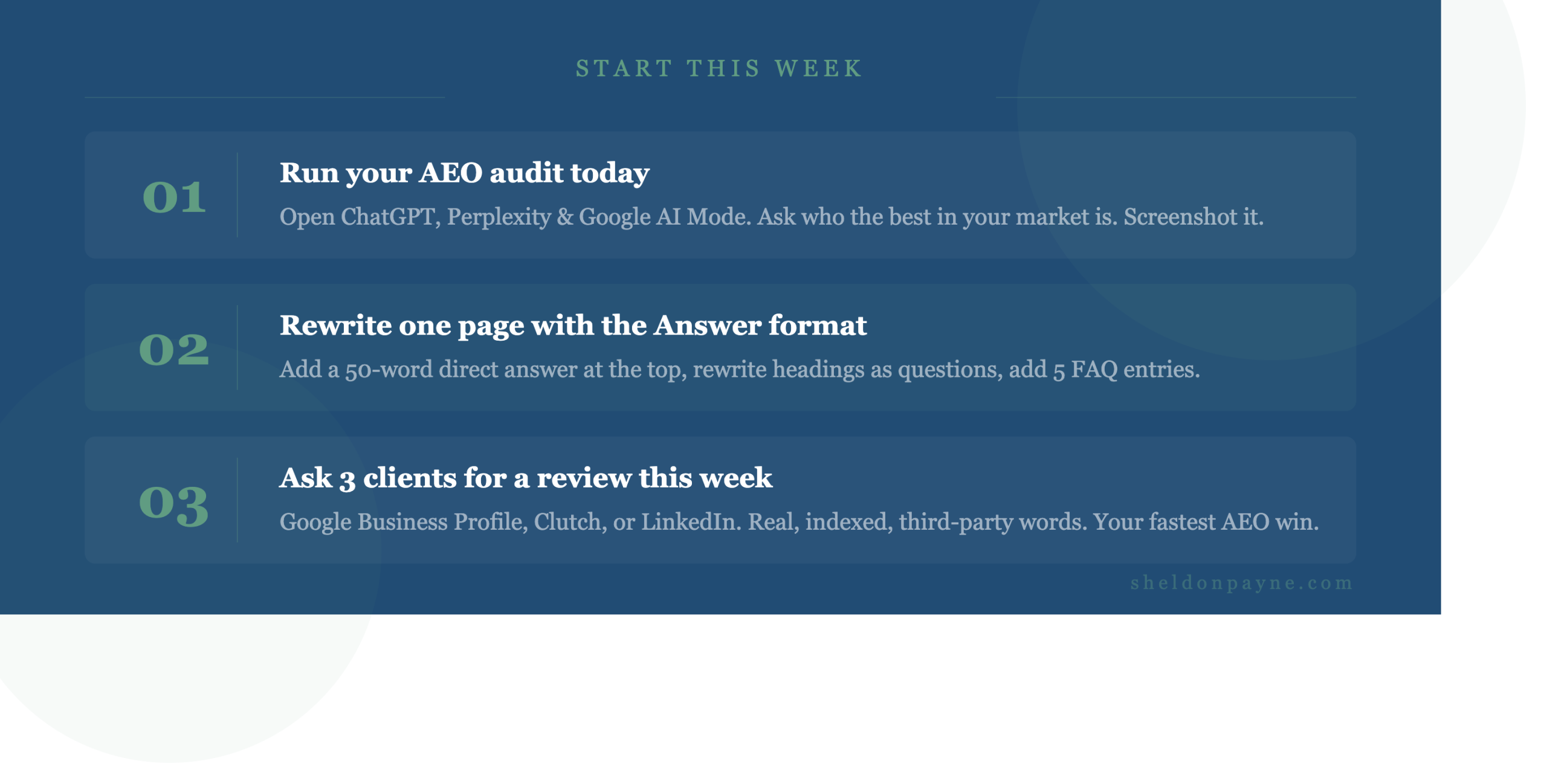
If you’ve read this far and you want to start, here are three actions that take under thirty minutes each and require no budget.
Run your AEO audit today. Open ChatGPT, Perplexity, and Google AI Mode right now. Ask who the best [your service] is in your market. Screenshot the results. That’s your baseline. Everything else builds from knowing where you currently stand.
Rewrite one page with the Answer format. Pick your most important service page. Add a direct 50-word answer to the implied question at the very top of the page. Restructure the H2s as questions. Add five FAQ entries at the bottom. This single change moves the needle faster than most things I’ve seen clients do.
Ask three clients for a review this week. Not eventually. This week. Google Business Profile, Clutch, or a LinkedIn recommendation. Real, indexed, third-party words about your work are the fastest AEO asset you can create.
Why This Matters More in Smaller Markets
One thing I want to be direct about: the opportunity is significantly larger in markets like Atlantic Canada than in major metropolitan centres. The first businesses to establish AEO visibility in a niche or geography tend to hold it. AI engines build consensus around sources over time, and that consensus is sticky.
In a market like Newfoundland and Labrador, or Atlantic Canada more broadly, most of your competitors haven’t started. The 20% adoption rate for AEO strategies isn’t higher in smaller markets — if anything, it’s lower. The window to establish a clear, defensible position in AI search results is open right now.
It won’t stay open indefinitely.
A Final Word on What This Requires
I want to be honest about one thing: AEO isn’t a tactic you run once. The businesses that will win at this over the next three to five years are the ones that build it into how they operate, how they create content, how they ask for reviews, how they engage in their communities, how they measure visibility.
The good news is that if you’ve been building a genuine community around your brand, showing up consistently, creating real value, earning trust, you’re closer than you think. You don’t need to start from scratch. You need to start being intentional.
Sheldon Payne is a digital marketing consultant based in Newfoundland. He helps businesses across Canada build visibility in an AI-first search landscape. If you want to talk through what AEO means for your business specifically, get in touch.


